Teaching in the future with Microsoft Interactive Classroom

Sometimes you discover a great learning tool, hidden somewhere on the web. The Microsoft Interactive Classroom is such a tool, and it gives us a taste of what classroom training might be in the (near) future. If you have ever wondered if they was way you could avoid printing tons of paper manuals, if you are tired of distributing PowerPoint handouts that nobody ever uses, this is for you.

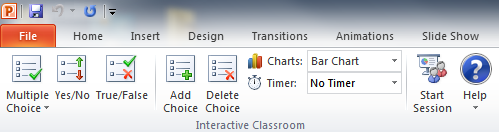
Basically, it is an add-on to PowerPoint and OneNote (2007 or 2010). As a teacher, you use PowerPoint to prepare your slides as usual, and you can use the Microsoft Interactive Classroom add-on to add question slides in your presentation. You get an extra tab in the ribbon for that:

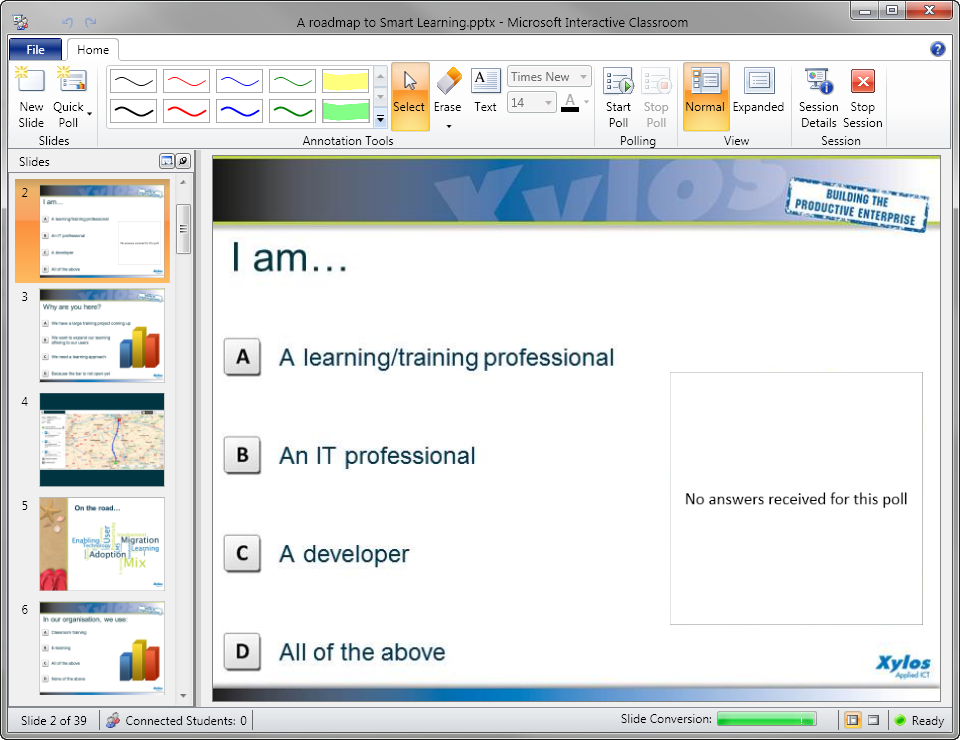
Once you start giving your session, you click the Start Session button. This starts a broadcast of your presentation on the network. Your screen will look like this:

With the ribbon, you can annotate your slides (works great if you have a tablet!) but also start polls, display the results of the poll to your students…

But the best feature is yet to come. Your students connect to your broadcasted session with… OneNote! They automatically get a copy of the slides as a separate note page, they can take their own notes on the slides, they see the annotations of the instructor in their OneNote… and after the session they go home with their own annotated lesson material. Of course, they need to be connected to the same network (wired or wireless).

We tried it during an interactive session of one hour with 20 workstations and it was quite impressive. And what is even better: it’s free!

Update: this tool is now officially part of Microsoft OneNote and called OneNote Class Notebookhttps://www.onenote.com/classnotebook

Why did Yanina not fill in her whereabouts?

tennisbal

I was watching the interview of tennis player Yanina Wickmayer where she explains why she did not fill in her whereabouts in the ADAMS computer system. As a result, she got suspended for one year.

I do not want to take any position about this decision (there are enough Facebook groups that do that), but this story reveals some typical problems that need to be addressed when introducing a new software tool:

  • Communicate clearly: the “business rules” need to be communicated clearly, so that the user knows the policy and guidelines. For that, you use the proper way of communication with your users (oral, e-mail, …) Sending letters to the home address of a globetrotter does not fall under “proper way of communication”.
  • Motivate: if your users know the philosophy of your application, why it makes things easier and what the benefits are, chances are much higher that the tool will be accepted.
  • Make it look nice:while applications are judged by IT people on their functionalities, the end users have a lot of interest for the “look & feel” of the application. If it looks good, your application will “sell better”.
  • Leverage technology: a web application is a good choice for a global, world wide application, but “a pc connection to the internet” does not seem to be always available to the sporters. But I’m sure they all have a Blackberry. Why not make a mobile app?
  • Train and document: the ADAMS application is a great example where the use of e-learning would be very appropriate: lot’s of users, spread over the entire world. Short demos, faqs, procedures…

WADA, Vlaamse Overheid, if you need any help, let me know. I see it as my contribution to Belgian top tennis.

Tips and best practices for screencasts

The people from TechSmith (Camtasia, Jing, Snagit…) recently polled their community for best practices and tips for creating effective screencasts, software animations, screen demo’s, whatever you want to call them.
They bundled the result in a 3-page booklet, in a kind of “tag cloud” format. Quick to read, and very valuable!

You can download it from their blog.

User adoption has not changed since the Middle Ages

A lot of IT projects fail because users struggle with the change that the new tools bring them. As an IT implementer or trainer, it is good to “unlearn” everything you know about the software, and view it from a user perspective.

The video below shows that what is simple, is not always obvious!

A great software experience

As an IT professional, you meet a lot of people who are disappointed, sad, angry or even frustrated about the quality of the software they need to use every day. Maybe it is good to share a positive experience with software…

A friend was celebrating her birthday, and as always a lot of pictures were taken. But the next day, the 4 GB SD card contained… nothing!

image In an ultimate attempt to save the pictures (they had been there, because we previewed them at the party on the camera), I called google to the rescue, to find a program called CardRecovery. I must say I was rather sceptical.

On the website, you could download a free trial version, that allowed you to preview the images, but not to recover them. That’s already something, at least you only pay when it works.

I installed the program, attached the camera, let it run for about half an hour, and… it showed me the preview of the 500 lost pictures! Including a “Buy Now” button, of course.

I clicked the button, payed the price (29 €, very reasonable), entered the license key, clicked “Next” and it recovered the pictures. I did not even have to close the program.

So you see, lighten up! There is great software out there!