iBooks, the future of course material?

If you are in the training and learning business, you know that course material always has been the subject of many discussions. Some say it is necessary, others say that they are never used, but most students want “a manual”. Entire forests disappeared because of it, the added value of it is uncertain.

What if you could avoid using paper, and make the manual really deliver added value? I spent some time playing with iBooks author, a manual in Word format about an IT application, and Adobe Captivate software demo’s, to see if this could be a valuable alternative.

The workflow to replace all your paper based manuals by this solution would be:

  • Get yourself a Mac :–)
  • Get yourself an iPad if you want to preview your iBooks
  • Download a copy of iBooks author
  • Import your Word document into iBooks author
  • Publish your Captivate demo’s as .mp4 (standard publish function in CP 5 and higher)
  • Convert your .mp4 files to .m4v with QuickTime
  • Insert the demos in your iBook using the Media widget
  • Add some interactivity if necessary, e.g. multiple choice questions
  • Publish your project
  • Distribute your iBook (via the store or as a file)
  • Get an iPad for all your students :–)

I will let you judge for yourself. This is the result:
Take a peak at Windows 8

Microsoft posted a video about the user experience in the coming version of Windows, Windows 8:

It is of course very early to draw conclusions out of this, but these are mine:

  • we need a design room like this for our team
  • it might be the end of “Windows” as we know it, because the only windows you see in the movie are the ones in the legacy applications
  • touch will become more and more important. Imagine this demo with a mouse and a keyboard…

Quotes from DevLearn 2010 #DL10

DevLearn 2010 has been an amazing three days of sessions, discussions, tweeting and playing. Too much to blog in detail, but I do want to share some quotes, one-liners and thoughts I heard and that I keep in mind. I hope I do credit the right people, if not, I do apologize…

Jay Cross and the Internet Time Alliance on Informal Learning:

  • An LMS can only be successful if people are “capable learners”.
  • Formal learning can be like a bus ride. People tend to fall asleep.

John Seely Brown on “The Power of Pull”

  • The purpose of a company in the 20th century is to minimize transaction cost and to achieve scalable efficiency. The purpose of a company in the 21th century should be to achieve scalable capability building.

Marcia Conner on “New Social Learning”

  • Together we are better.

Thornton May on “The New Know”

  • Your network will keep you safe

Of course, there were a lot more sessions that were less conceptual but more specific, and thus produce less “quotable content”. Many thanks to all the speakers for sharing their knowledge and kudos to the people of the E-learning Guild for organizing a top event.

Teaching in the future with Microsoft Interactive Classroom

Sometimes you discover a great learning tool, hidden somewhere on the web. The Microsoft Interactive Classroom is such a tool, and it gives us a taste of what classroom training might be in the (near) future. If you have ever wondered if they was way you could avoid printing tons of paper manuals, if you are tired of distributing PowerPoint handouts that nobody ever uses, this is for you.

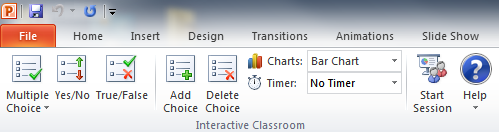
Basically, it is an add-on to PowerPoint and OneNote (2007 or 2010). As a teacher, you use PowerPoint to prepare your slides as usual, and you can use the Microsoft Interactive Classroom add-on to add question slides in your presentation. You get an extra tab in the ribbon for that:

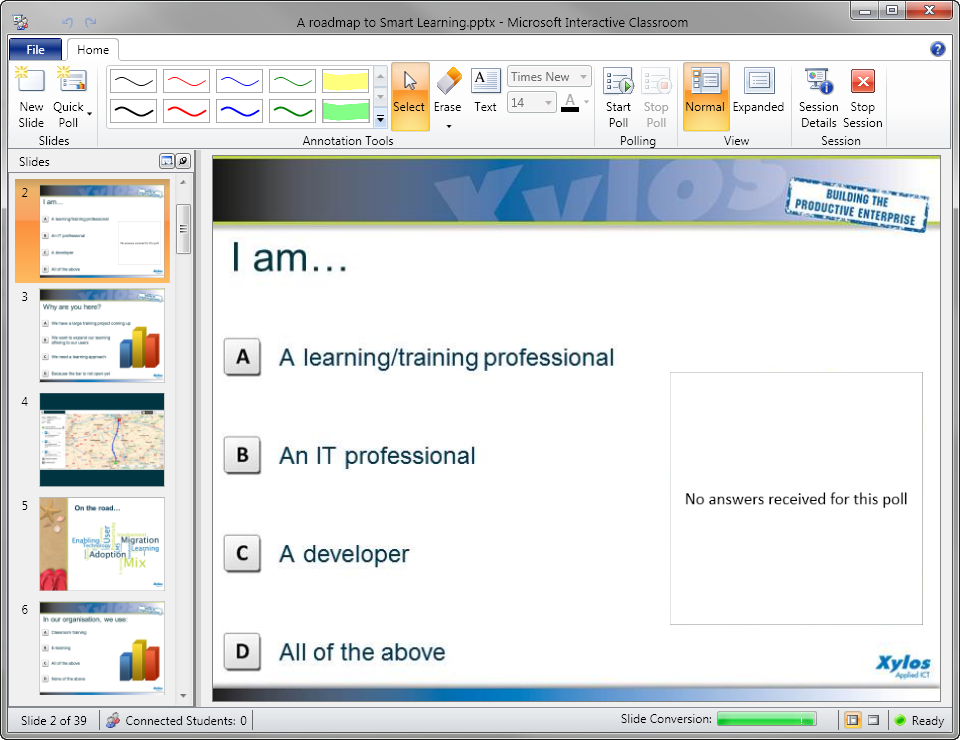
Once you start giving your session, you click the Start Session button. This starts a broadcast of your presentation on the network. Your screen will look like this:

With the ribbon, you can annotate your slides (works great if you have a tablet!) but also start polls, display the results of the poll to your students…

But the best feature is yet to come. Your students connect to your broadcasted session with… OneNote! They automatically get a copy of the slides as a separate note page, they can take their own notes on the slides, they see the annotations of the instructor in their OneNote… and after the session they go home with their own annotated lesson material. Of course, they need to be connected to the same network (wired or wireless).

We tried it during an interactive session of one hour with 20 workstations and it was quite impressive. And what is even better: it’s free!

Update: this tool is now officially part of Microsoft OneNote and called OneNote Class Notebookhttps://www.onenote.com/classnotebook